You see it at about eleven in the morning, in a lift mirror or a shop window, and it is always the same small betrayal. A fine line under the eye where the concealer has gathered into a thin ridge. A patch beside the nose where the foundation has separated from the skin and started to sit on top of it. Nothing dramatic, nothing anyone else would notice from a metre away, and yet it changes how the whole day feels. Most people respond by buying something new. Almost nobody responds by changing the two things that actually cause it, which are the amount of product on the face and the state of the skin underneath it. The best makeup hacks are unglamorous for exactly that reason.
The Crease Is a Message, Not a Defect
Foundation does not crease randomly. It creases where skin moves, where skin is dry, and where there is more product than the surface can absorb.
That is useful information. A crease under the eye means the area is either under-moisturised or over-powdered, or both at once, which is a common combination because people powder the eye area precisely to stop the creasing and end up causing it. A crease at the nasolabial fold means the foundation there is thicker than the surrounding skin can carry. Separation on the nose means oil and product have stopped cooperating.
Read this way, creasing stops being a verdict on your face and becomes a diagnostic. Every line tells you which variable to change, and none of them require a new foundation. Most require a smaller amount of the one you already own.
Reading Your Own Face Before You Buy Anything
The single most expensive mistake in base makeup is buying for the result you want rather than the skin you have. That is how people end up with a matte, long-wear formula on a dry face, or a dewy, hydrating base on skin that produces oil by ten in the morning.
Texture Zones: Where Foundation Behaves and Where It Fails
The face is not one surface. Treating it as one is the reason a base looks good in one area and poor in another.
The centre panel, across the nose, between the brows and around the mouth, is usually the oiliest and the most mobile. It needs the thinnest layer and the most careful setting. The cheeks are flatter, less mobile and often drier, and they tolerate a slightly richer formula. The under-eye area is thin, almost without oil glands, and constantly moving with every blink, which makes it the hardest place on the face to keep smooth. The perimeter, along the jaw and hairline, is where blending matters more than coverage.
A base applied identically across all four behaves badly in at least two of them. A base applied with three different amounts behaves well in all four.
Why the Same Base Looks Flawless on Someone Else
The variables that determine whether a foundation works are mostly invisible in a review.
Skin type comes first, and it changes over a lifetime. Climate comes second, because humidity and indoor heating change how a formula behaves within hours. The state of the skin barrier comes third, and it fluctuates with stress, sleep, travel and season. Then there is the question of what is underneath the foundation, meaning skincare, primer and sunscreen, each of which interacts with the formula above it.
Two people using the same product in the same city can have entirely different results because of any one of these. Which is why copying someone else’s routine rarely works and understanding your own zones almost always does.
The Prep That Decides Everything
Nearly every creasing complaint traces back to the ten minutes before the foundation. It is the least glamorous part of the routine and the only part that reliably changes the outcome.
The Order of Skincare and the Pause Nobody Takes
Skincare goes on in thin layers, from lightest to richest, and each layer needs a moment before the next one.
The mistake is speed. Applying serum, moisturiser, sunscreen and foundation within ninety seconds means four products are still moving when the fifth arrives, and the foundation ends up floating on a mixture rather than sitting on skin. Three to five minutes of waiting is the difference between a base that grips and a base that slides, and it costs nothing except a small rearrangement of the morning.
If time is genuinely short, there is a shortcut that works better than rushing. Apply the moisturiser, then brush teeth or make coffee, then return. And if the skin still feels tacky, press a clean tissue over it before foundation. Removing the excess is faster than waiting for it to disappear.
Exfoliation: the Honest Frequency
Flaky skin and foundation do not coexist. Product catches on lifted edges, and every dry patch becomes visible within an hour.
The temptation is to exfoliate harder, and this is where a great many people damage their barrier and make the problem permanent. Aggressive daily scrubbing, strong acids used too often and physical exfoliants with rough particles all produce the same result, which is temporarily smoother skin followed by inflammation, dehydration and more flaking.
The honest frequency for most people is two or three times a week with a gentle chemical exfoliant, or once a week with something mild. Mature and dry skin often needs less. Oily skin tolerates slightly more. If skin stings when moisturiser is applied, the exfoliation is too frequent, and the correct response is to stop rather than to add a soothing product on top.
Hydration Versus Moisture — and Why Both Are Needed
These two words are used interchangeably and they describe different things.
Hydration is water content, and it comes from humectants such as glycerin, hyaluronic acid and panthenol, which draw water into the upper layers. Moisture in the cosmetic sense usually means lipids, the oils and fatty alcohols that seal water in and keep the surface supple.
Skin that is dehydrated but adequately oily looks dull, feels tight and makes foundation sit in fine lines. Skin that is oily but well hydrated can still be flaky on the surface. The fix in both cases is water first, then a sealant, in that order. A hydrating serum under a lightweight moisturiser handles both, and this single adjustment resolves more creasing complaints than any product swap.
Choosing a Base That Suits the Skin You Have
Once the skin is prepared, the formula matters, and the language on the bottle makes that harder than it should be.
Finish, Coverage and Formula: Three Separate Decisions
Finish describes how the surface looks: matte, natural, dewy or satin. Coverage describes how much is hidden: sheer, medium or full. Formula describes what the product is and what it does over time: water-based, silicone-based, oil-free, long-wear, hydrating.
These are independent. A sheer hydrating foundation and a full-coverage hydrating foundation can both exist. A matte long-wear formula with light coverage exists too. Confusing them is how someone buys a “natural finish” product expecting medium coverage and concludes that foundations do not work on their skin.
The practical rule is to choose formula for the skin’s behaviour and finish for personal preference. Coverage can always be built with a second thin layer; a formula that fights your skin cannot be fixed.
How to Test Properly and What Most Tests Get Wrong
The hand is not the face. The skin on the back of the hand has different texture, different oil production and usually a different depth of colour, which is why so many people come home with a foundation that matched in the shop and does not match in daylight.
Test on the jawline and slightly onto the neck, three shades side by side, in daylight rather than shop lighting. Then leave it for fifteen minutes, because foundation oxidises and darkens as it dries, and the shade that looked right at minute one is often a shade too deep by minute twenty.
The best test of all is a sample worn for a full day. Ask for one, apply it as you normally would, and check it at the four-hour mark in daylight. That tells you about oxidation, creasing, separation and comfort in a way no counter ever will.
Application Hacks That Change the Result
Here is where the largest gains are available for the smallest effort, and almost all of them involve using less.
Less Product, Built in Thin Layers
A single pump of foundation is enough for most faces, and often it is too much. Two very thin layers cover better than one thick one and look considerably more like skin, because the layers bond to each other rather than sitting as a slab.
The technique is to start at the centre of the face, where coverage is usually wanted, and work outward with whatever remains on the tool. The perimeter needs very little. If you find yourself adding more product at the edge, the issue is usually blending rather than coverage.
The Tool Question: Brush, Sponge, or Fingers
Each tool produces a different texture, and none is universally better.
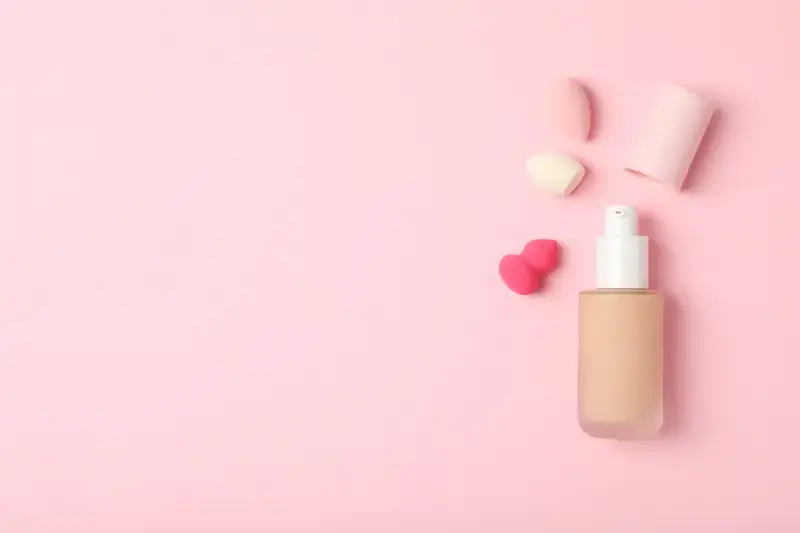
A dense brush gives the most coverage and the most speed, and it leaves a slightly textured finish that some skin types wear well. A damp sponge gives the most seamless result because it presses product into the skin and lifts the excess, and it is the most forgiving tool for anyone prone to over-application. Fingers work well with thin, fluid formulas because body heat thins the product, and they are the kindest option for dry or mature skin.
The one combination that reliably fails is a wet sponge with a thick, fast-drying formula, which produces patchiness that no amount of blending repairs.
Pressing Instead of Sweeping
This is the smallest hack on the list and possibly the most effective. Foundation that is pressed into the skin bonds to it. Foundation that is swept across the surface sits on top and moves when the face moves.
Use a stippling or pressing motion with a sponge, and short tapping movements rather than long strokes. Around the nose and the under-eye area, where creasing starts, this makes a visible difference within one application.
The Concealer Problem: Where Creasing Actually Begins
Most people who say their foundation creases are actually describing their concealer. The under-eye area is thinner, more mobile and less oily than anywhere else on the face, and it is where product is most often applied thickly.
The Triangle Myth and the Real Placement
The old advice to draw a large triangle under the eye and fill it in produces a thick layer exactly where the skin folds most.
A better placement is a small amount at the inner corner, where darkness concentrates, and a light touch outward along the lash line, stopping before the outer corner where the skin is driest and creasing is worst. Two tiny dots per eye, pressed in with a fingertip or a small damp sponge, is usually enough.
If the darkness is pigmented rather than shadowed, a thin corrector underneath in a peach or apricot tone allows you to use much less concealer on top, which is the actual solution. Less product means less to settle.
Baking, Setting and the Powder Debate
Baking, the technique of pressing a heavy layer of powder under the eye and leaving it to sit, was designed for stage and photography and then moved into everyday routines where it does considerable damage.
On oily skin it can work. On dry or mature skin it reliably emphasises every line, because powder absorbs the little moisture that area has. A lighter version of the technique, using a small amount of finely milled powder pressed only into the inner corner and the very edge of the fold, gives much of the benefit without the dehydration.
The general principle for the under-eye is that powder should be minimal, applied with a small brush, and pressed rather than swept. And it should go on after the concealer has had a moment to settle, not immediately.
Setting Without Caking
Setting is the step that decides whether a base looks like skin or like a mask, and it is almost always overdone.
Powder Only Where Skin Moves
The face does not need powder everywhere. It needs it in the places that produce oil or move against themselves.
That means the centre panel, the sides of the nose, the chin, the inner under-eye and the nasolabial folds, and nothing else. The cheeks and the perimeter can be left alone, and the result is a face that still has light and dimension rather than a uniform matte surface.
The tool matters here too. A large fluffy brush picks up more powder than necessary. A small brush or a velour puff gives control, and pressing the powder in with a puff sets it more effectively than dusting it across the surface.
Setting Spray: Finishing Touch or Fixative?
Setting spray does two things. It melts the layers together so that powder stops looking powdery, and depending on the formulation it can add some genuine wear time.
What it cannot do is rescue a base built on too much product or the wrong formula. And used at the wrong moment, before powder, it dissolves the foundation and produces the exact separation people are trying to avoid.
The correct order is foundation, concealer, powder, then spray, held about twenty centimetres away, in a light mist, and left to dry without touching the face.
Fixing the Midday Collapse
A base that has been through six hours needs maintenance, not reconstruction, and the difference matters.
The first move is always blotting. A tissue, a blotting paper or even the back of a hand pressed gently over the oilier areas removes the excess that is causing separation. Often that is the entire fix. Applying powder over oil without blotting creates a paste that looks worse than the shine did.
The second move is targeted. A touch of concealer at the inner corner, a press of powder on the nose, a refresh of lip colour. Nothing else. A face that is fully rebuilt at lunchtime looks heavier than it did at eight in the morning, and that heaviness is visible for the rest of the day.
The third move is restraint about touching. Hands on the face transfer oil and disturb product, and the crease that appears at two in the afternoon is frequently self-inflicted at one.
Special Cases: Mature Skin, Oily Skin, Humid Weather
Standard advice assumes standard skin, and most people do not have it.
Mature skin has less oil, thinner texture and more movement, so the priorities invert. Richer skincare, no powder under the eye, a hydrating formula, and application with fingers or a damp sponge. Cream products generally behave better than powders on this skin, and less coverage always looks younger than more.
Oily skin needs the opposite approach in the centre and the same approach everywhere else. A mattifying primer in the T-zone only, a long-wear formula applied thin, powder pressed into the areas that shine, and blotting rather than powdering through the day.
Humid weather changes how everything behaves, because foundation absorbs moisture from the air and emulsions separate. In humidity, thinner layers, powder only where necessary, and a formula that is water-based rather than rich. In dry indoor heating, the opposite, with more hydration and a creamier base.
Conclusion
The best makeup hacks for a crease-free base are almost embarrassingly simple, and none of them involve buying anything. Prepare the skin properly and let each layer settle. Match the formula to how your skin behaves rather than to how you would like it to behave. Use half the product you think you need and build in thin layers. Press rather than sweep. Conceal small areas rather than large ones, and powder only where the face actually moves. Blot at midday instead of reconstructing.
What makes this hard is not the technique. It is the patience, because the routine that produces a seamless base is the one that takes five extra minutes in the morning and looks slightly underdone at the start. It is also the one that still looks like a face at six in the evening, which is the only test that matters.
And there is something quietly reassuring in that. A crease is not a sign that your skin is failing or that you have not found the right product yet. It is a signal that something small can be adjusted, today, for free. Most of the beauty advice people receive asks them to spend. This asks them to slow down, use less, and let the skin do some of the work.